
Lawrence Shankland
Lawrence Shankland is Rangers' first signing of this summer. I take a look at his game in depth and discuss how he will fit in at the club.


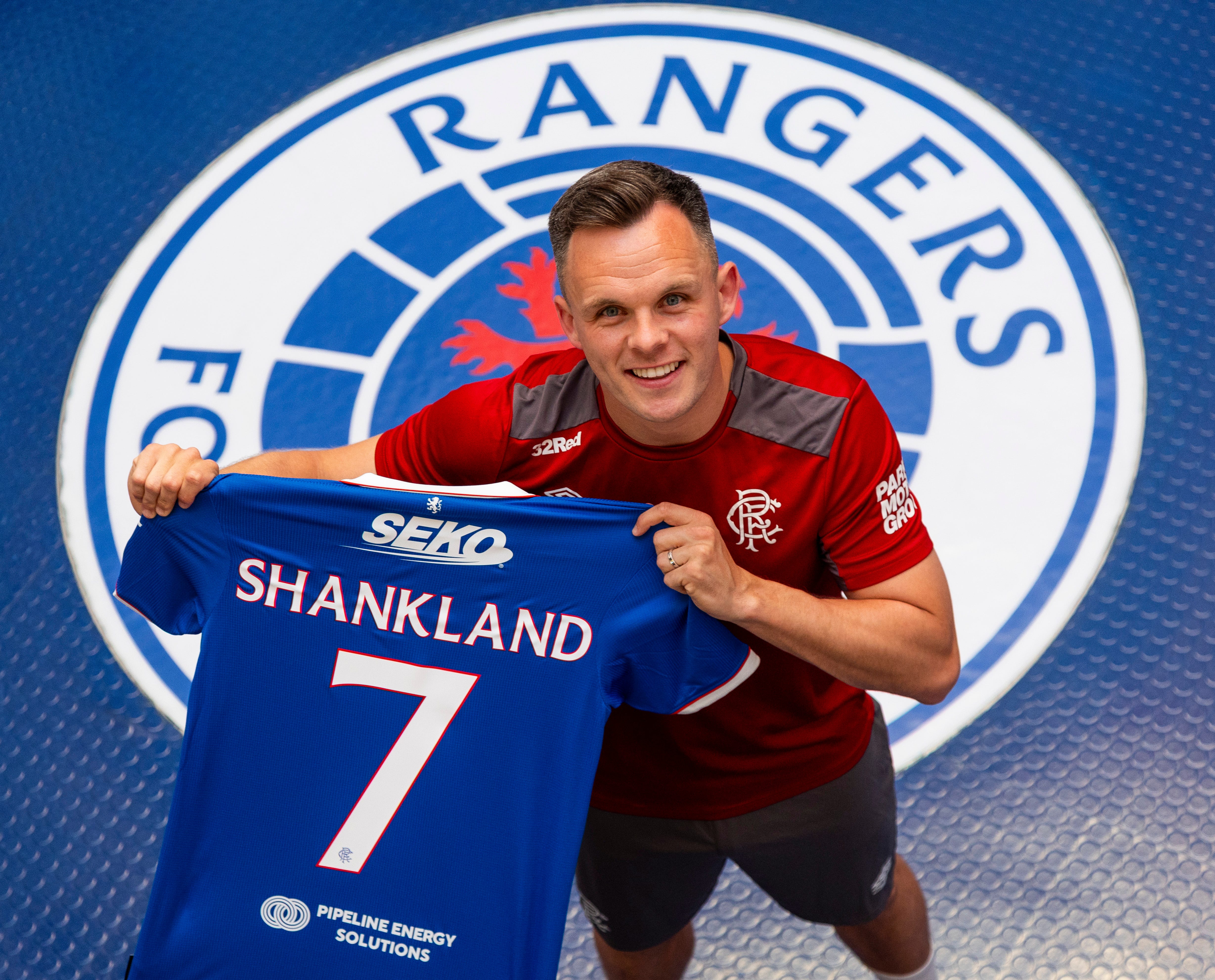
Lawrence Shankland is finally a Rangers player. The club announced his signing last week after years of being linked to the club. He is the first signing in what must be a busy window for the club, coming in for free due to a contract clause.
Since his move to Hearts he has been seen by most Rangers fans as a bit of a “no-brainer” signing. His goal record and knowledge of the league being the main qualifications cited by fans when making that case.
Unlike my last piece on Elliot Watt most fans are already very aware of Shankland and his abilities, having watched him for years. Still, I think there are some parts of his game that are overlooked when discussing how his play will translate to Ibrox.
There are a lot of differences in playing as a striker for Rangers compared to Hearts, as well as considering exactly how Shankland will fit into the current Rangers system. So let’s consider Lawrence Shankland as a Rangers player.
Shankland played most of this season as a sort of second striker, behind Claudio Braga. This is similar to the role Bojan Miovski played behind Chermiti, dropping deep to connect the play and then making a move towards the box.
Out of possession he was usually tasked with marking the opposition number 6, while Braga pressed the centre backs.
Strengths
For Hearts, Lawrence Shankland has been one of the leagues most skilled and efficient finishers. Outperforming his expected goals (xG) in 2 of his last 4 seasons at Tynecastle.
Shankland can score on either foot, generating a lot of power even without the time and space to step into the strike. When he does get that time, he can catch keepers out from range with this power and incredible accuracy. He has most types of finish in his locker as well, able to improvise and score from difficult positions.
The most important thing for a striker when stepping up a level is the speed at which they get shots off. The quicker a striker can set themselves and strike the ball, the more likely they are to score. Goalkeepers won’t be ready and defenders have less time to get a block in.
This is an area in which Shankland is really good, he excels at first time shots and takes very little strides before firing shots when running onto the ball. I think his goal against Rangers in the first meeting of the season sums this up well.
Notice in the clip above how quickly he gets into his shooting motion, it’s almost one step when he arrives at the ball before he’s already shooting. Despite the angle being against him, the quick strike catches Jack Butland off guard.
This clip also brings us onto Shanklands’ next strength, his movement. Shankland isn’t a physical striker generally, he will use his strength to break free of people tracking him but would rather avoid being tracked in the first place.
He likes to take his position on the edge of the box and react to the space as it develops. Notice for the goal against Rangers, Shankland fights off Diomande and then sees Djiga plant his feet. He instantly reacts to the space opening up and makes himself available.
This goal against Livingston is really where Shankland wants to be, he settles on the edge of the box as Hearts recover the second ball. When Shankland sees the cross coming in, he immediately reacts to the space, sprinting in for a free header.
The final strength of Shanklands’ that I would like to talk about is his ball progression. Despite what you might expect, Shankland isn’t a particularly strong hold up striker. What he is good at is linking play through the thirds, you see him drop deep to receive from the midfield and quickly find a teammate further up the pitch.
Shankland was the second best progressive passer compared with other Premiership strikers with over 1000 minutes played this season, averaging over 3 progressive passes per 90 minutes.
If Rangers plan to continue with the 4-4-2/4-2-2-2 formation this season, then having a striker able to connect play through midfield will be a big help.
Weaknesses
There are a few areas that Shankland struggles with that I think are important to consider when evaluating him as a Rangers striker. The first one most will be aware of and that’s his pace.
Shanklands’ acceleration in particular is his biggest problem. His speed when running in open space is okay, not good, but okay. When he has to move off the mark quickly to reach a pass, the limitation is noticeable.
Moments like the clip above are when this issue is most clear. When Shankland wants to combine in smaller spaces, his inability to accelerate stops the play from happening.
He tries to play a combination and drive into space at the end of the clip but is beaten for pace by a player who is behind him when they start running. Because of the effort he requires to speed up and get to the ball, Shankland reaches it while off balance and is easily brushed off by the defender.
The other big weakness in Shanklands’ game is his decision making on the ball. He will hold on to the ball for too long or play the wrong pass going forward very often. Some of this is the natural selfishness that you expect from a striker but there are some moments that show really poor decision making.
In the clip above, Hearts break away 3vs3 with Shankland in possession. On his right, Kyziridis breaks free of Hatate but Shankland seems completely unaware of his run. He holds on to the ball for too long, allowing Hatate to get back. The play ends with Shankland forced into a poor pass to Braga.
He will also shoot from range consistently when there are better options available. This is generally forgivable as you don’t want to deter strikers from shooting but there are some decisions that are egregious.
One of these poor decisions can be seen in the clip below, Hearts turn the ball over and Shankland receives in front of the Livingston back line. He then fires off a very ambitious strike instead of putting his winger in on goal.
Shanklands’ poor decision making is exacerbated when he has to think very quickly. You will often see him receive on the counter and play a speculative pass rather than slow down and maintain possession.
Conclusion
I think there are two factors outside of his play that make this signing particularly desirable compared to previous seasons. The first is that Rangers already have a solid striker in Youssef Chermiti, who’s form since the turn of the year has been excellent.
Chermiti and Shankland have a lot of attributes that compliment each other. Chermiti is much more of a runner, similar to Shankland’s former partner Claudio Braga. You can expect him do to a similar job in terms of creating pressure while Shankland does the man marking.
Chermiti wants to hold up and combine rather than be the connector that Shankland is, providing a distinction in how each can be used in a partnership. Shankland is also much more likely to handle the easy chances, taking some pressure off of Rangers’ young striker.
The other factor is, of course, the price. Getting Shankland for free is great business and adds a lot to the squad in terms of the off pitch attributes that Rangers seem to be looking for. You would normally have to pay a premium for a captain that scores so many goals.
He also provides a face that fans already know and believe in, which is important at a time where the support lacks belief in the squad overall.
The strengths and weaknesses I have highlighted throughout this article outline pretty clearly how Shankland should be used in this Rangers team. His best place is to be used as the deeper partner to Youssef Chermiti.
I think he would struggle if consistently used as a solo striker in the high speed, counter pressing system that Danny Rohl seems to prefer. Domestically he can find a lot of shooting opportunities outside the box on turnovers and be able to use his great movement when Rangers load the box in possession.
In games where you are consistently on the counter (European games mostly), Shankland is probably better placed as a substitute who can come on and nick an important goal. This limits the impact of his struggles with decision making on fast transitions.
In the end I think Shankland will do what he’s always done, which is score goals at a strong rate. The level of his scoring will likely depend more on the cast Rangers surround him with more than Shankland himself. Rangers now need to focus on creativity if they want to gest the best out of their new goal getter.
Now we’re talking!!!!!!!!
Not entirely convinced of the viewpoint identified by, "a striker when stepping up a level". Is Shankland really stepping up a level? What is a level? He's competing in the same league against substantially the same opponents. Did Hearts do enough last season to suggest that the traditional "Old Firm first and second, the rest nowhere" model has some cracks in it? And the better Hearts do, the more it encourages Motherwell, Hibs etc to go into OF matches with a strong ambitious mindset.
Personally, I think Hearts have probably had the best of Shankland. At Ibrox he won't be a star fixture but more likely a squad or bench player. There will be less incentive for Röhl to give him 90 minutes every game than if he'd been a £5m headline capture. Shankland will have to adjust to this.